



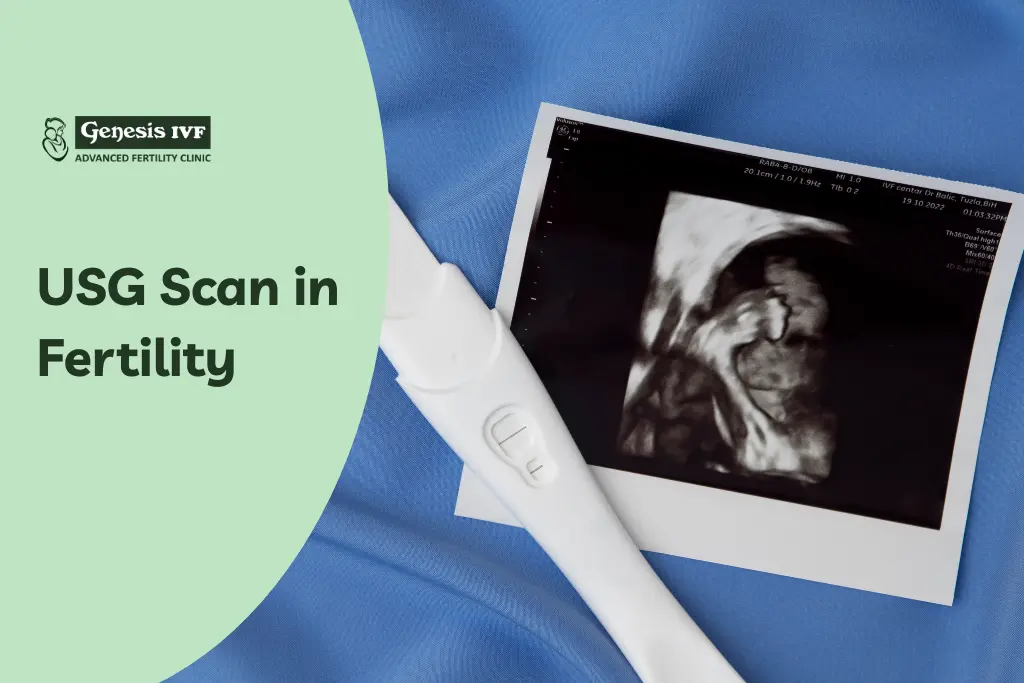
When couples begin their fertility journey, diagnostic scans play a crucial role in understanding reproductive health. One of the most common and vital investigations is the USG scan in fertility, a safe, non-invasive imaging method that provides real-time visuals of the uterus, ovaries, and reproductive organs.
At Genesis IVF Clinic, our fertility experts use advanced USG technology to guide every stage of treatment, from diagnosis to embryo transfer, ensuring the best possible outcomes for our patients.
What is a USG Scan?
USG stands for Ultrasound Sonography.
It uses high-frequency sound waves to create detailed images of internal organs. For fertility treatments, USG helps doctors assess ovulation, follicle development, uterine lining, and overall reproductive health.
Types of USG Scans Used in Fertility
1. Transvaginal Ultrasound (TVS)
- Involves inserting a small probe into the vagina.
- Provides clear images of ovaries, follicles, and endometrial lining.
- Used during ovulation tracking, IVF cycle monitoring, and embryo transfer.
2. Abdominal Ultrasound
- Performed on the lower abdomen with a gel-based probe.
- Useful for assessing uterine abnormalities and pregnancy progression.
3. Follicular Study (Series USG)
- Series of transvaginal scans done across a woman’s cycle.
- Tracks follicle growth and ovulation timing.
- Critical for IUI and IVF success rates.
4. Doppler Ultrasound
- Measures blood flow to the uterus and ovaries.
- Helps detect endometrial receptivity and ovarian reserve.
Importance of USG in Fertility Treatments
1. Detecting Causes of Infertility
USG helps identify:
- Polycystic Ovaries (PCOS)
- Fibroids and cysts
- Endometrial thickness issues
- Uterine abnormalities
2. Guiding Treatment Plans
Doctors use ultrasound data to:
- Time ovulation accurately
- Monitor follicular growth during stimulation
- Check embryo implantation zones
3. Monitoring During IVF
USG ensures:
- Safe egg retrieval
- Accurate embryo transfer
- Proper luteal phase support
Benefits of Ultrasound in Fertility
- Non-invasive and radiation-free
- Real-time visual feedback
- High accuracy for diagnosis
- Ensures treatment safety
- Detects early pregnancy success
When Should You Get a USG Scan?
Day 2-3: Baseline ovarian check
Day 9-14: Follicular growth monitoring
Day 21: Luteal phase assessment
What Happens During the Scan?
- You lie on the examination bed.
- A trained sonographer applies a sterile gel.
- A small probe transmits harmless sound waves.
- The live image appears on the monitor.
Why Choose Genesis IVF Clinic for USG Scans
- Specialized fertility imaging unit
- Experienced embryologists & radiologists
- Advanced 3D/4D ultrasound machines
- Female-friendly environment
- Custom fertility scan packages
FAQs About USG Scans
Q1. Is a USG scan painful?
No, it’s painless. You might feel slight pressure during a transvaginal scan.
Q2. How long does a fertility USG take?
Usually 15–20 minutes.
Q3. Do I need to fast before the scan?
No fasting is required, but a full bladder helps in abdominal scans.
Q4. Can USG detect ovulation?
Yes, follicular monitoring tracks ovulation precisely.
Q5. Is USG safe during pregnancy?
Absolutely. It uses sound waves, not radiation.
Conclusion
A USG scan is the foundation of fertility evaluation. At Genesis IVF Clinic, our advanced ultrasound technology helps uncover hidden fertility challenges and guides treatment precision from start to finish.
If you’re planning your pregnancy or undergoing fertility care, book your USG scan at Genesis IVF Chennai today.